Showing posts with label sexual harassment. Show all posts

Thursday, September 2, 2010

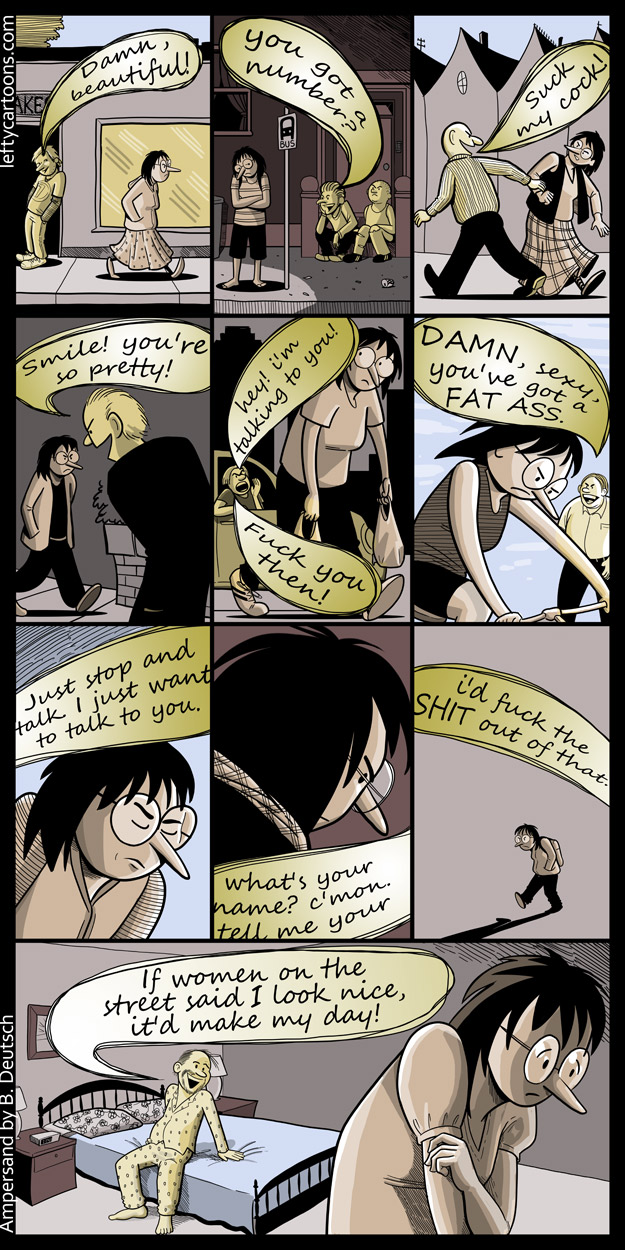
Street Harassment comic

This comic, found here, sums up way too many of my experiences.

I could literally tell hundreds of stories about street harassment that I have experienced, one of the most intimidating was a look without any comments at all. I could also tell a few stories about being physically attacked by men who thought that it was ok to force himself on me. I don't think it is fair to try and separate street harassment from physical and sexual violence.

Now, when I am walking in nearly deserted school hallways, I always get that knot in my stomach if there is a man walking behind me. Although it isn't fair to men for me to always assume the worst, it is a much better option than assuming otherwise and getting hurt. This is how it works for me, and I'm sure this is true for many women; we hear about sexual assault a lot, it plays on television, we have been warned about how to protect ourselves since adolescence (if not childhood), we know people who have experienced it, and many of us have experienced it ourselves. Upon hearing comments, such as those depicted in the image above, I am reminded about my position in relation to men. And I am reminded that men are usually stronger than I am. And I am reminded that we live in a culture where the objectification of female bodies is normal. This is why I don't welcome street harrasment, even the most 'innocent' comments.

J (daughter) learned about street harassment when she was only 4 years old. Everyday, when she got home from Junior Kindergarten, we would walk 5 minutes to her brother's daycare and another 5 minutes home. And more often than not, I would get harassed while holding J's hand and pushing a stroller with a 2 year old inside. At first, she thought that people were honking because they knew me, but it didn't take her long to realize that I didn't know that many people. Some comments were difficult to explain, mostly things like whistles, "hey baby" and "want a ride?" but sometimes vulgar comments were made even when I was with my children. And this happens regardless of what I am wearing.

Daring to go outside while female does not mean that my body is public property for men to look at and discuss. It does mean that I have to take added safety measures, compared to most men that I know. It means that I check the backseat before getting into my car. It means that I don't use specific parking lots on campus when I have night classes (which sometimes costs me money). It means that I usually avoid going outside alone at night, and the odd time that I do, I learn rather quickly not to do it again (at least for a while).

And I am not being irrational, as so many people have suggested. This is a real fear, not just for me, but it has been written and blogged about by so many other women... the fact that the above comic exists means that it is something that is really affecting the lives of women. My suggestion for men is that if you want to approach a woman on the street, maybe try holding back and just smiling from a distance. If she maintains eye contact and smiles back, then consider approaching. If she does not, than she is not interested at the moment. That does not mean try harder, it means leave her alone.

Sunday, January 17, 2010

Primetime television and the continuum of violence against women

In this post, I will attempt to bring awareness to some of the ways women are portrayed in primetime television by mentioning a few examples of rape culture and women's sexual availability to men from recent episodes. I am sure there are hundreds of examples, and feel free to add any more you think of in the comments.

Private Practice
Addison and Mark, two doctors who have had a relationship in the past, are discussing some recent problems in their lives. Addison mentions that she wishes there was some kind of drug to help her cope, that she wants to put something on top of the pain. Mark proceeds to undress- to which she responds "I said put something on top of it, not put you on top of me." He continues to take his clothes off and talk about how horrible his life has been recently, and she has a change of heart and they have 'great' sex right there on the floor of her office. In this case, no means keep trying.

Numb3rs
A female police officer is sexually harassed by a detainee (who was originally suspected of murder) with comments about her appearance and their potential compatibility as a couple. He persists, even after she angrily tells him to stop. Then, when he is not looking, viewers see her smile as though flattered by his persistence, leaving the impression that women enjoy mens' advances, even when we pretend we don't.

Castle
I don't know how detective Kate Beckett could have given stronger signals to author Richard Castle to back off. She repeatedly tells him to leave her alone, even threatening violence if he comes too close to her. She does not consent to have him nearby, but the mayor gave him permission to follow her on investigations, and she must now accept his presence in order to keep her job. He then goes on to give unwanted comments on her appearance and personality in every episode, and, unfortunately, it seems as though he is slowly winning her over. She is not the only woman who must endure his sexist remarks, as he makes similar comments about most of the hegemonically attractive women on the show, even, on occasion, murder victims.

Mad Men
There have been three rapes on this show now, by my count, and in many message boards, none of them are talked about as rapes. The first was between fiances, so it isn't really rape... it is often referred to as sort-of-rape, nevermind that marital rape has been a crime in Canada for 20 years. The second is often not referred to as assault because a relationship followed the initial attack. And in the third, a woman repeatedly (but politely) rejected a man's advances, even telling him not to come in to her house, but submitted when he came in anyway and forcibly kissed her. What is often ignored in message board posts about this particular event is that submission does not equal consent. I believe that the intent of the writers is to show real situations in which sex can be coerced, and therefore non-consensual. I am appalled (but not necessarily surprised) by how many viewers fail to label it as such.

That 70's Show
This specific scene plays through my mind often, annoying me further every time (especially since it is one of my favorite sitcoms). Kitty (the mother of the teenage main character, Eric) was grocery shopping, when Kelso (Eric's friend and classmate) grabs her buttocks, not realizing that it is his friend's mother because her back was turned. After some harsh words, she smiles and says thank you before walking away with a bounce to her step. This leaves the impression that women not only enjoy mens' advances, but that women like men to touch them, even when we pretend that we don't.

I'm not even going to touch on shows like Dollhouse or crime dramas, that portray sexual harassment and assault in various ways.

There are so many examples in pop culture where women submit to mens' advances after repeatedly telling them they are not interested, or are shown as being flattered by behavior that is actually quite threatening, that it normalizes these behaviors in our everyday lives. It teaches men that it is ok to persist, because we might change our mind, or we actually like it when strangers comment on our appearance when we are walking down the street... I mean, it is meant to be a compliment... we can't expect them to understand the power dynamics or the implied threat involved.

In Surviving Sexual Violence, Liz Kelly talks about violence against women as a continuum. This continuum includes many acts that western culture deems trivial, such as catcalls, pressure, and implied threats, and places them as no more or less severe than other forms of abuse. These acts are all connected to “the everyday aspects of male behaviour” (256) and therefore work to reinforce other behaviors.

All of these examples work not only to undercut women's power, but to limit acceptable forms of masculinity, thereby created a culture in which nobody is exempt from strict regulations on how to do gender.