Showing posts with label sexuality. Show all posts

Tuesday, May 17, 2011

International Day Against Homophobia and Transphobia

May 17th is International Day against Homophobia and Transphobia. There has been a facebook meme going around, apparently not very extensively because it has yet to show up on google, but I've seen it on 3 friends' walls saying

Today is International Day Against Homophobia. Donate your status for an hour to promote tolerance.

(note that transphobia is missing on this status, which says a lot)

So, what does tolerance mean? According to WordWeb (my usual choice of dictionary/thesaurus), the second definition is "a disposition to allow freedom of choice and behavior" which is good, but the first definition is "The power or capacity of an organism to tolerate unfavourable environmental conditions." Because of this part of the definition, it concerns me that people are still using this language.

I don't want to be tolerated. That sounds to me like being accepted despite my sexuality. Still, I am hoping that this doesn't sound overly critical, or like a personal attack on those that posted that status update. I think that, for the most part, people who talk about tolerance have the best of intentions, I am just trying to point out some of the impacts that the words we use could have on how we think about specific issues. I updated my facebook status to;

Today is international day against homophobia and transphobia! I've read several posts about tolerance, and I would like to say that it is a start, but I don't think the goal should be to merely tolerate queer people, but to fully embrace and accept diverse sexualities and end dichotomous thinking about gender and sexuality.

I'm not going to belabour this part any further, as I think it is rather self-explanatory. I will, however, mention a few more things about language.

I am torn on using the words homophobia and transphobia. On one hand, I think that the words are useful because they are easily understood. On the other, using 'phobia' still leaves the impression that the problem is a few hateful acts by bad people. Most people that I encounter on a daily basis are not homophobic, and homophobic acts are important to point out when they occur, but if that is all we look at, then things look much better than they actually are for non-heterosexual people. Because of this, I personally prefer the term heterosexism when looking at the ways in which the lives of queer people are affected by a culture where monogomous heterosexual relationships are considered to be the norm.

Until the late 1970s, the term homophobia was used to describe "irrational, persistent fear and dread of homosexuals." Using the word irrational implies that there are rational reasons to fear or dread homosexual people... I wonder what these reasons could be. That definition has since expanded to include more subtle attitudes and behaviours such as contempt or aversion. This allows us to see things other than violence or angry epithets as homophobic, but it misses a lot of what is going on. The term heterosexism looks at how society is organized around the premise of heterosexuality as the natural sexuality. It looks at privilege more than hatred. And, it allows us to look at ways in which heteronormativity is built into ruling relations.

On that same note, monosexism implies that people are attracted exclusively to either men or women, which leads to many stereotypes about people who identify as bisexual, pansexual, fluid, queer, two-spirited, or any other label or lack thereof that implies that one might be attracted to more than just one specific sex/gender, including assumptions that there are only two genders. There are many stereotypes about bisexual people; that they are sex-crazed, they cannot maintain monogamous relationships, that they are just going through a 'phase', that they are really gay but haven't fully come out yet. I have included this because I am really working to bring awareness to this issue, as a lot of people have never so much as heard the terms 'biphobia' or 'monosexism'.
I did not include transphobia in the above paragraphs on language because I think it could be wrong for me to say that most people are not transphobic... I think that many people are. Transphobic jokes are told on the radio and that is considered entirely appropriate even when I pointed it out to the station and wrote letters to Rogers Media about it. Television programs, even ones I usually like (Big Bang Theory, for instance) sometimes make use of transphobic humor, which makes me think about not watching them anymore. I think that we need to problematize the duality of gender, as it is typically conceived of right now throughout much of the west, I still think that the negative connotations to the word phobia gives it a lot of power that might be useful if we want to come to a place where making fun of trans people is considered to be inappropriate, just as blatantly racist and homophobic jokes are largely (although not yet entirely) considered to be unacceptable throughout mainstream media.

Thursday, January 20, 2011

Lesbian visibility; short hair and men's clothing

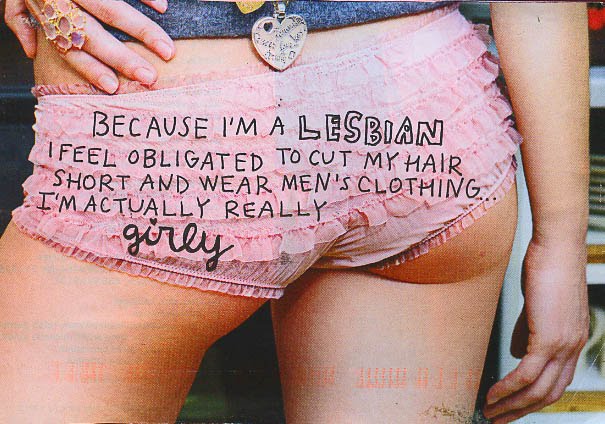
I saw this picture from postsecret on sociological images

it reads "because I'm a LESBIAN I feel obligated to cut my hair short and wear men's clothing... I'm actually really girly"

When I first came out, someone told me that I couldn't be a lesbian because I had long hair. This 'someone' was a lesbian... a 'real' lesbian... who had never dated men, had short hair, wore men's clothing, and had plenty of other lesbian friends. I, on the other hand, had hair that was long and curly and that I stubbornly refused to cut (not because I liked the long hair, but because I didn't want to conform to any stereotypes). I also wore tight clothing that was considered stylish by most, spent lots of time doing my makeup... basically looking 'hetero' by conforming to what the magazines had told me to do since I was a teenager.

This made it very hard to get a date. I think there were two reasons for this. First is visibility... when dressed 'girly' other lesbians couldn't identify me as a potential dating partner. The other reason is related to biphobia, as having children and an ex-husband meant that I wasn't really "one of them" which made finding a dating partner difficult even when the people around me knew I was gay.

Once I started to dress more masculine, things got easier. I cut my hair (more because my long hair was completely fried and damaged from hair dye than for reasons related to conforming). Once I cut my hair, I also found myself wearing jeans and T-shirts everyday. I found lesbians start to pay attention to me. And I started to get more credibility as a queer person.

Even now, when I am going out to bars as a single person, I will dress more masculine than if I am going to the bar with a date so I am not mistaken for a straight girl at the gay bar.

My clothing style is not particularly masculine... I am a HUGE fan of big sweaters and leggings, but I still have short hair and never wear makeup. The grad student association has a semi-formal coming up, and I have had several people specifically request photos of me in a dress and heels because they have never seen me dress feminine before. I have also been informed that I am supposed to shave my legs for the occasion... but I digress

I think the point I am trying to make is that although there is a practical reason for lesbians (or women who date other women, whatever label they use/don't use to identify themselves) to dress in masculine clothing and have short hair, it makes me sad to see that someone is changing who they feel they are in order to conform to a specific standard. How is this any more liberating than having to wear heels and makeup in order to attract men?

Tuesday, January 18, 2011

Queering It Gets Better

I love this depiction of the "It Gets Better" movement.


Found here

The picture, with comments like "made with white privilege" and "0% class awareness" shows an important critique of the movement. It refers to this niche that middle to upper class white gay men have found where they can fit in and happily consume products. And capitalism benefits immensely from their spending power.

Like the last post that I wrote that was critical of the "It Gets Better" movement, I feel like I need to explicitly say that I am glad it is happening. I like the attention that it brought and is currently bringing to queer issues, and I think it is important to tell young people that it generally does get better. I just think that we need to push it further to try harder to make things better now. I worry that by saying that it will get better, we are at the same time justifying the abuse that teens face as "kids being kids."

I don't think that it would have made me accept my own sexuality any sooner had a few relatively wealthy urban white men told me that it would get better. What happens to those of us who cannot inherit this white male privilege? What about trans youth? People of color? Queer people with disabilities? Poor or working class queer people? What happened to the queer movement that did not fit into dominant and consumerist norms?

We are replacing one normative culture with another, very similar, prescribed set of rules and calling it transformational in some way. I think we need to queer the It Gets Better movement.

Sunday, January 9, 2011

Update on homophobic office rant

This is an update to a previous post, which can be seen here, in which I was subject to a homophobic rant at my office.

When I woke up on the morning after this incident, I thought I was fine. I got the kids ready for school, ran a few errands, and went into the office. As I got closer to the university, I realized that things were not as 'fine' as I had previously thought, but I still wasn't prepared for the knot of anxiety that I felt in the pit of my stomach as I approached the office door. I was also not prepared for the sound of my keys bouncing off each other as I tried to open the door with a trembling hand, afraid that he would be on the other side. He wasn't.

Still, as I got ready to begin work, just as I do every morning, I realized that something was different and I am not sure that it will ever be quite the same again. My office is a place where I had always felt safe. I had found a little niche where I could exist as I am without having to hide or conform, without having to pretend to be something I am not without having to worry about being judged or discriminated against. The place I could let my guard down and not have to worry about the anxieties that I often feel while dealing with people in the "real" world outside of this bubble.

And I am confused because he never touched me, he never made me feel as if I was in any kind of physical danger, never so much as raised his voice. Maybe that is why it didn't hit me until I really started thinking about the words that he used. If he had yelled or made me feel physically threatened, then I would have really seen the words for what they were from the beginning. But his tone was almost pleasant, conversational... in the context of words that were so full of not-quite-hidden hatred, or at very least ignorance, it made the entire situation seem even more surreal.

And the part that frustrates me most is that I can't get over being mad at myself. I am angry that I didn't tell him off or at least really explicitly tell him that it was inappropriate and that I wanted him to shut his mouth right then and there. I wasn't entirely quiet... at first, I tried to argue with him, but then just tried to ignore him in the hopes that he would stop talking, but he didn't, so I left the room. Either way, rationally I know that I am not to blame and that putting any blame on myself for his words is unhealthy and part of the victim blaming trend that I have written about so often (although I don't like that term... and I am definitely not thinking about myself as a victim in the context of this incident).

When I talk about it, people seem surprised that I didn't fight back. I am known for being argumentative when I want to be and for not backing down from an argument or debate, so it makes sense that those who know me are shocked that I didn't say or do anything. Still, acting shocked that I didn't say or do anything makes me feel as though I was wrong, and that isn't helping me right now.

Another friend just told me that although he doesn't condone that behavior, it is probably because the person was attracted to me. Then said something about how guys are jerks and it can be hard for them to behave properly around attractive women. So, basically what I got from that conversation was that it is my fault because I fit into a specific box of what could be defined as attractive by some people's standards (despite the fact that I don't wear makeup and rarely wear "figure flattering" clothing). Is the solution, then, to make even less effort with my appearance or should I excuse him for just being male?

And to make matters worse, I just received a non-apology letter, saying things like I'm sorry if you were offended by our openly intellectual conversation... you should have told me to stop... sorry if you thought i was rude or offensive. NOT sorry for being rude and offensive, but just apologizing if I interpreted it that way, because he is clearly open-minded about sexual orientation (he said as much in his letter), and I am the one with the problem for not seeing that. That letter should never have been allowed to be sent as an apology.

So, now I am sitting at home, not wanting to be alone, but not wanting to go on campus either. I am dreading tomorrow because it is the one morning that I know he will be there and I am pretty sure that he is angry with me for not seeing our 'conversation' as intellectual/academic. And the way that this is being handled is making me as angry, or possibly moreso, than the original rant... and I thought things were being handled so well up until late last night.

Thursday, January 6, 2011

Cure for lesbianism discovered by my colleague

I had an interesting conversation today with someone... and by interesting, I mean horribly homophobic, sexist and offensive. I wasn't going to mention anything about context in order to not identify this person, but the context is quite important. I was in my office at the university, which is one of my favorite places... somewhere that I am surrounded by graduate students working on a degree in sociology in a program that has an emphasis on social justice. If there is anywhere that I feel safe, it is my office. Not so much today.

The word girlfriend was mentioned in conversation, and he said "what do you mean girlfriend?" So I said I was gay (something I assumed everyone here knew, but apparently not), and he went off on this huge tangent.... starting with "I'm not against that BUT" and, as I've mentioned in numerous previous posts, if you have to say "but" in that context, you are better off not speaking at all.

As he was speaking, after getting over the shock of what I was hearing, I began furiously writing down what he was saying as he was saying it so I could quote as much of it as possible here for the benefit of readers.

I feel I need to mention that he doesn't think he is homophobic because he is ok with people being gay, he just thinks that they are wrong in that they are not actually gay, they just haven't yet realized that they are straight. Here are a few quotes, the ones without quotation marks are paraphrased;

"If she is with a good man who is doing his job as a man, women will prefer the man"
He didn't say exactly what it meant to do your job as a man, but I can guarantee you that dating a man who was doing whatever that job happens to be would not be enough to make me attracted to him for long. But it is good to see that the gender binary is alive and well in sociology.

There are two types of lesbians, one who will always play the man, which I don't understand, but for the one who plays the woman, there is nothing that a woman can give her that a man cannot
I wonder which "type" of lesbian I am... probably the latter. I did wear a skirt on New Years Eve, but I have also been described as moderately androgynous. Is that more or less wrong than "playing the man"? Few things annoy me more than the assumption that all relationships need to follow some kind of dichotomous gender construct.

If you cannot stay attracted to men, it is the fault of the men that you have dated. You have built up stereotypes in your head on the image of the men, which limits your view of how men can satisfy your needs
Ah, I see. I am gay because I was raped. Or maybe I'm gay because my daughter's father was abusive. Or because my ex-husband was sexist. Or because my dad left when I was 3. Or all of the above. Good to know. Am I 'cured' yet?

This line of thinking scares me, as I believe it makes lesbians particularly vulnerable to sexual violence from men in certain ways.

"The link between men and women is a frontier, and it is really hard to penetrate that frontier"
ummmm... what?

If a gay person starts dating the right person of the opposite sex, they will no longer be gay. It depends on their experience of dating.
This one particularly offends me because it is exactly what I had convinced myself. This misconception is the reason I got married to a man. It is the reason that I dated men exclusively for 6 years. It is the reason that I hated myself for not being able to conform to heteronormativity.

"I know it cannot be better" (gay as opposed to heterosexual relationships)
Yes, for many of us, not only can it be better, but it is better.

"but i'm not against that..."
No, not at all. You are CLEARLY ok with non-hetero lifestyles. You just think that we are all tricking ourselves.

After politely, but vehemently disagreeing with him (multiple times), I had to leave the office and rant to a queer studies prof in the department. I wasn't sure if I should tell him off, or just try to let it go... I'm still not entirely sure. On one hand, I have to see this person all of the time, we share a tiny little office. On the other hand, holy homophobia batman.

Sunday, November 7, 2010

SPARKsummit video on the sexualization of girls in the media

This video, on the sexualization of girls and women in the media, is from the SPARK summit, SPARK stands for Sexualization Protest: Action, Resist, Knowledge.


I would suggest that it is more about objectification and the culture of beauty than it is about sexualization or sexuality. I think that they need to make sure to differentiate between sexuality and sexual objectification. Maybe it has something to do with being made for young teenage girls, but I find that the video comes across as being opposed to all forms of female sexuality in the media, as opposed to being opposed to the objectification of women and girls. I see this as being closely linked to slut-shaming.

That being said, I do like the message that they are trying to get across, and I agree that it is important get young girls to actively decide to watch on TV, but I just think this particular video is somewhat blurred with anti-sex messages.

Friday, October 15, 2010

Heterosexism, Homophobia and "It Gets Better"

I have been watching the news (and various TV programs, as well as reading blogs and news articles) covering the recent deaths of several gay teens and young men. Like so many others, I am saddened and outraged that the suicide rate is so high for this group. I also would like to mention that it is not any higher than usual this month, there has just been media coverage stemming from the circumstances surrounding Tyler Clementi's death. I would also be curious to investigate whether this is also the case with other queer groups... I know the suicide rate is astronomical for transgendered people, but I haven't seen any reports of lesbian suicides over the past month and am not as aware of what these statistics might look like.

Many celebrities, in an attempt to prevent more suicides, have began a campaign entitled the "It gets better" project. I am happy that they are trying to help, and I am glad that so much attention is being brought to the issue, but I have some problems with the concept of it gets better. I feel like I need to add a disclaimer of some sort, because I don't want this to come across as being overly cynical... I think this campaign is important to continue, despite what I am about to write. I think that it is a good start to opening up debate on bullying, especially in relation to people who identify as LGBTQ (I never know how many more letters to add here). And I think that it could conceivably help to save some lives. That being said, I think that it is quite limited and limiting, and should be opened up into a broader campaign to make things better now, instead of getting people to hope that it will get better for them someday.

To me, it is almost like they are condoning the bullying (which is far from their intention). They are saying that it won't last forever, but it can come across as "yes, kids will be cruel, but when they are all grown up, you will be able to find a niche within society where you can fit in most of the time." Note that it is not saying that broader society becomes more accepting, only that these celebrities have found a place where they fit without the bullying.

Another teen committed suicide right after a city council meeting, when after having been told that it would get better, he realized that some things never change when he heard adults giving homophobic arguments opposing LGBT awareness month.

My uncle has told me (and anyone else who will listen) that non-hetero lifestyles are wrong because his God said that a man should be with a woman. Yet, his god is fine with him emotionally abusing his wife, and his god is fine with him being financially abusive to his family, and his god is fine with him screaming at my sister (who, due to a mental illness and past trauma cannot handle loud noises or angry people). I am all for people believing in whatever they want to believe, but I don't want a god who is ok with being cruel to people, but not ok with allowing two consenting adults to have a relationship because they have the wrong genitals for each other. (after reading this part back, I want to note that I am not saying that he is representative of religious people or any religion specifically, merely an example of how things, in my life, have not always gotten better).

As I was walking to the bus stop this morning with my 5 and 8 year old children, I am pretty sure a neighbor yelled a homophobic slur at me. It wasn't loud enough to be clear, and I am a bit on edge due to a really upsetting bullying incident that I faced at the co-op earlier this week, but even if I try to give her the benefit of the doubt, I can't think of what else she might have said. And when I told my best friend about this, his response was that I should be more careful who I tell that I am queer. I understand that he means well, he is concerned about me and trying to protect me, but why should I have to live closeted or in fear? I have not had girlfriends over to my house or done anything for people to label me as gay (not that it would matter if I did), but I have told a few people in private conversation when it came up because I don't feel like it is something that I should need to hide. My sexuality is such a huge topic of discussion for community gossip that people who I don't even recognize know that I am The Gay person in the co-op.

Do people get better? I am not so sure... It is not something that I have to face everyday, so maybe it does get better... but does it ever end?

Overall, the people in my life are generally more accepting than they were highschool, not because it gets better, but because I spend most of my time at university. I study in the social sciences and work in an academic union, where people are generally open to all kinds of things that are not accepted throughout some areas of broader society.

I was reading one of my favorite blogs, which said that instead of "it gets better" maybe we should change slogans to "make it better." I would suggest reading the post, especially if you are interested in this from the point of view of someone who Taught While Gay (brilliant... I only hope my kids get a teacher like this).

Why should we ask children to tolerate the bullying at all, even if it does get better? How do we accept that any child anywhere is being bullied for sexual orientation, nevermind when it is this widespread. What is the most insulting word that you can call a teenage boy? I'm guessing most would say it is a gay slur or feminine term (you probably know which ones I am talking about, I'm not going to repeat them here, that is not what my blog is about).

So, how do we fix this, if not by telling children that it gets better and hoping that someday it actually will? It seems so simple... end institutional forms of heterosexism. Sarah Silverman made an excellent point when she said
Dear America, when you tell gay Americans that they can't serve their country openly or marry the person that they love, you're telling that to kids too. So don't be fucking shocked and wonder where all these bullies are coming from that are torturing young kids and driving them to kill themselves because they're different. They learned it from watching you.

What we learn from instutionalized heterosexism is that to be queer is to be different. And if we are different, than we can be treated differently. And because the assumption that we are somehow different is taken as common sense, then it becomes ok to say that it will get better eventually, instead of making it better for everyone NOW.

Saturday, August 28, 2010

Real boys can't dance

I was at my son's soccer party today and really had to bite my tongue at another mother's comment... one of the parents was talking about enrolling her daughter in dance this fall. Another mother said (and I wrote this down right away so I could quote it)
I wish I had girls. I only have boys so I can't put them in dance cause that would be a little, you know... (trails off).
A little what? Gay? I was about to tell her off right there, until I realized that we were surrounded by 5 year old children. I started to think about how to approach this when another parent stepped in and talked about the cute little boys in her daughter's dance class.

As a former dancer/ figure skater/ gymnast, I have heard the boys is my classes get ridiculed for being there by their peers. Were some gay? Probably, but then, some hockey players probably were too. Most were not gay. It is just another example of things that are designated as feminine being off limits for males.

Wednesday, April 28, 2010

Still trying to decide what I think about Lady Gaga...

I saw this great video with a male acapella group singing a Lady Gaga medley (mostly Bad Romance)


I thought I'd use it as an intro to some thoughts on Lady Gaga. I have to admit, I am not overly familiar with her as an artist; I have heard her songs that regularly play on the radio, I play Pokerface on the piano and Bad Romance on the guitar, and I find her music fun to dance to, but I do not have any of her albums, nor do I have her songs on my playlist. What I have been following more closely is some of the discussions around whether or not she is a feminist.

She claimed that she is not a feminist, saying "I'm not a feminist - I, I hail men, I love men. I celebrate American male culture, and beer, and bars and muscle cars..." Then, she apparently realized that loving men and being a feminist are not incompatible because she later said "I'm getting the sense that you're a little bit of a feminist, like I am, which is good" and goes on to discuss how the music business can be different for women than it is for men.

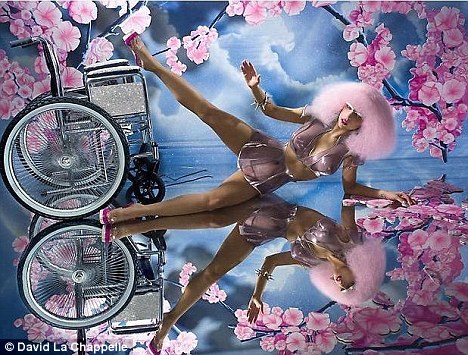
Another thing she did that I think is great is alternate representations of people with disabilities (found here), which, on the one hand, show interesting images of different types of bodies that do not entirely fit in to "normal" images within pop culture. On the other hand, some argue that she is sexualizing the disabled body (which may or may not be a problem).


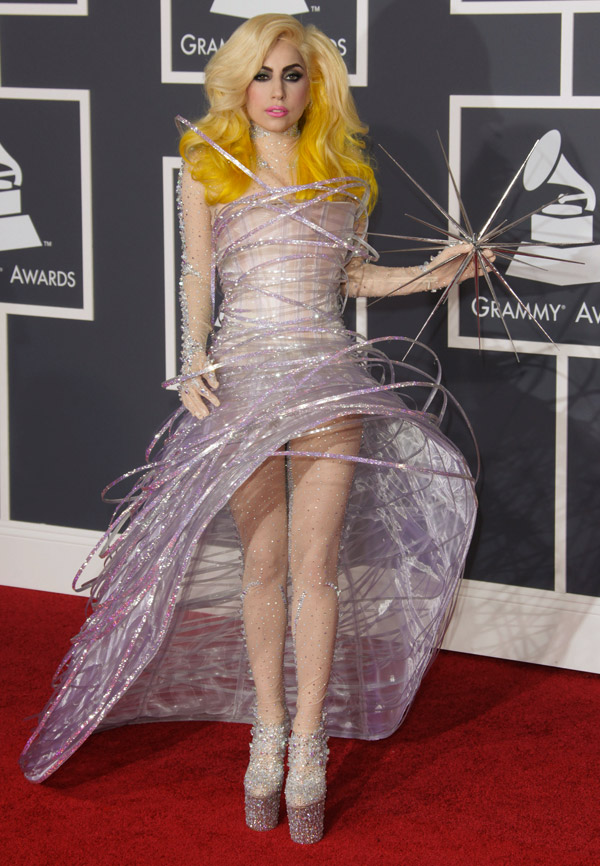
I think my favorite thing about Lady Gaga is how she takes images typically found within pop culture, such as poses or fashion, and changes it just enough to make a different type of image. Yes, she does conform to dominant beauty standards in many ways, I'm not sure she would be all that successful if she didn't, but sometimes I find she changes what would otherwise be a very sexual image just enough to make it different. For example, even though her clothes can be revealing, the weirdness of them takes away what might otherwise be blatant sexuality to turn it into something interesting as opposed to simply fitting into the male gaze.


However, her new video Telephone (found here), seems to conform to a more dominant music narrative, including revealing clothing and tons of product placements... Maybe it could be read differently- it does feature one of the few "butch" lesbian images in modern pop culture, and there could be meaning behind the products and lack of clothing... maybe I just don't get it this time.

Anyway, I'm wondering other people's opinion of her, whether it be related to feminism or academia, or just personal likes/dislikes about her music...

Wednesday, April 21, 2010

Sex Education in Ontario: Beyond abstinence only curriculums

There is a new sex education curriculum in Ontario that is being strongly opposed by "family values" groups.

Some of the highlights are
Grade 1- taught to identify body parts by their proper names, including male and female genitalia
Grade 3- curriculum includes gender identity, sexual orientation, and same-sex marriage
Grade 5- identify reproductive organs and describe puberty changes
Grade 6- taught about masturbation, as well as definitions for terms like "vaginal lubrication"
Grade 7- STIs, AIDS, and unwanted pregnancy prevention, including information about oral and anal sex.
Grade 8- Taught about the importance of abstinence as a positive choice, but not as the only choice. They are also taught about pregnancy prevention and how to find support for issues relating to a healthy sexuality.

Dr. Charles McVety, president of Canada Christian College, claimed that
"Little eight-year-olds, they're going to be taught they look one way on the outside but they may be the opposite on the inside... This is so confusing to an eight-year-old ... these are children in the strongest sense of the word -- they're innocent, they're clean, they're beautiful -- and to corrupt them by imparting a question of gender identity is beyond the pale."
Would talk of gender identity confuse an 8 year-old? Probably not, I think most third graders are more open to these ideas than many adults... and it might help a lot of children accept how they feel about their own bodies.

I am troubled by the perception that children are pure and innocent. Children are in need of protection and nurture from adults in order to survive. Adults are supposed to provide them with the necessities, like food and shelter. In western society, adults must also protect children from "secret" adult knowledge, such as sexual relations, money, violence, illness, death, as well as specific social relations and language. This is not always the case historically or in many other cultures, where children sleep in the same room as parents and it is not uncommon for them to see their parents having sex.

Children are constructed as pure, innocent and in need of protection from adult knowledge, when I believe that they are merely ignorant because of this so-called protection. I have heard it argued that this ignorance can make them more at risk because the concept of innocence can be arousing to abusers, it can stigmatize children who have figured out these secrets, and it makes them more vulnerable to abuse when they don’t have the words to describe what is happening or the knowledge to understand what is acceptable and what is not.

The importance of teaching youth about the dangers of sex is widely debated, but it is much less controversial than the concept of teaching them about the pleasures of sex- which is something that this curriculum does not quite get into, but is bordering on. In order to be successful in most aspects of life, children are taught to practice. They spend countless hours doing homework to practice for a test, training for a sport, or learning a musical instrument. What they are not taught is that sexual pleasure also takes practice; in fact, they are shamed into not practicing. The safest way to practice would be to masturbate, but instead of being encouraged to do so, they are made to feel guilt over autoeroticism and sexuality itself. The importance of having a healthy sex life in adulthood is rarely discussed in school curriculums.

Children, and especially teenagers, know that sex exists and trying to end premarital sex is an effort in futility. Rather than continuing to fight this losing battle, children should be 'protected' by being given complete and accurate information about sex. I hope that teachers get the training necessary to deliver this information to students in a way that does not shame them into avoiding questions and not getting the information that they need.

In a lecture on the problems with abstinence only education, a women's studies professor argued that everyone (even children) deserve to practice with as much information at their disposal as possible.


edited to add: Upon re-reading this, I thought I might end up with comments telling me that it is wrong to push sexuality onto children... Just to make it clear, I am not suggesting that we actively encourage young children to masturbate, or give them step by step instructions on how to do so... I am merely saying that we need to make sure they have all the information they need available to them so that when they do decide to experiment with their body in various ways, they are able to do so without being embarrassed or ashamed of themselves.

Wednesday, February 24, 2010

blame feminism...

I have been trying to avoid talking about the Tiger Woods scandal since it first happened, mostly because I do not believe that somebody's extramarital affairs should take precedence over more important news issues on the local television news as the lead story EVERY night for more than a week, but I saw a paper on his apology that presents a position which I feel needs to be addressed.

Dr. Wendy Walsh, a clinical psychologist, blames women for Tiger's infidelity. She actually writes "How can we blame our husbands for getting wet on their way home from work when IT'S RAINING WHORES?" I detest these essentialist arguments that men somehow can't help sleeping around when women are sexually available, and it is the duty of women to be sexually chaste... I mean, it's not like women have real desires anyway, other than seeking "their fifteen minutes by kissing and telling on national television." She suggests that they need to become mothers in order to understand Elin's position... somehow having given birth will help women understand that they no longer need to be sexual.

She writes:
"Thanks to feminism, women own their own orgasm and a box of Trojans."
I thought great! That's what should be happening! But I guess I didn't read it as she meant for it to be taken, because she goes on to say that divorce and children born out of wedlock are a problem caused by feminism. Not that I think having children out of wedlock is inherently problematic, but if we were really "owning" our Trojans, most children would be planned, and teen/unplanned pregnancy, abortion and STI statistics show that this is not the case.

It makes me angry to read articles like this, especially when it is written by a woman, although I should be just as angry regardless of who writes it. It is not feminism's fault that Tiger Woods, or any other man, had an affair (or many affairs). Blaming women does nothing other than make it easier for people to forgive Tiger while demonizing all women who are not sexually conservative. I see this argument as part of a larger anti-feminist culture of victim blaming and slut-shaming. I don't think that Tiger Woods should be forced into hiding forever for his 'indiscretions' but I do not like that so many people are giving him a free pass while blaming women into tricking or luring him into sleeping with them.

Tuesday, January 26, 2010

California school district bans dictionary

A California school district banned the Webster's Collegiate dictionary from fourth and fifth grade classrooms because it defines the words "oral sex." A committee of parents and teachers then decided to bring the dictionaries back, but to let parents decide whether their child is to be able to access this dictionary.

I can't get over how far these parental consent issues at school have gone. I don't think it should be up to parents to decide whether their children are allowed to look at a dictionary. I also do not think it should be up to parents to decide whether or not their children should have access to comprehensive and accurate sex education- I think children have the right to this information. There is little that annoys me more than denying people information that they want/need for no reason other than an authority figure doesn't think it is appropriate... why not just present facts and various arguments surrounding them, and teach children to think for themselves?

Nevermind this debate over whether or not it is acceptable for ten year olds to have access to this information, I wonder how many students have actually gone to the dictionary to look up the term "oral sex". I would guess very few of them... although, as punishment for talking in class, I occasionally had to write out dictionary definitions. It would have been slightly uncomfortable (or amusing) had I randomly selected that page... but no more so than with a multitude of other words. It doesn't mean they should be banned from classrooms.

I guess we now need to ban the internet as well. I would much rather my children get information from the dictionary than google... at least I know the stuff in the dictionary has been filtered through various editors to ensure it's accuracy.

Sunday, January 17, 2010

Primetime television and the continuum of violence against women

In this post, I will attempt to bring awareness to some of the ways women are portrayed in primetime television by mentioning a few examples of rape culture and women's sexual availability to men from recent episodes. I am sure there are hundreds of examples, and feel free to add any more you think of in the comments.

Private Practice
Addison and Mark, two doctors who have had a relationship in the past, are discussing some recent problems in their lives. Addison mentions that she wishes there was some kind of drug to help her cope, that she wants to put something on top of the pain. Mark proceeds to undress- to which she responds "I said put something on top of it, not put you on top of me." He continues to take his clothes off and talk about how horrible his life has been recently, and she has a change of heart and they have 'great' sex right there on the floor of her office. In this case, no means keep trying.

Numb3rs
A female police officer is sexually harassed by a detainee (who was originally suspected of murder) with comments about her appearance and their potential compatibility as a couple. He persists, even after she angrily tells him to stop. Then, when he is not looking, viewers see her smile as though flattered by his persistence, leaving the impression that women enjoy mens' advances, even when we pretend we don't.

Castle
I don't know how detective Kate Beckett could have given stronger signals to author Richard Castle to back off. She repeatedly tells him to leave her alone, even threatening violence if he comes too close to her. She does not consent to have him nearby, but the mayor gave him permission to follow her on investigations, and she must now accept his presence in order to keep her job. He then goes on to give unwanted comments on her appearance and personality in every episode, and, unfortunately, it seems as though he is slowly winning her over. She is not the only woman who must endure his sexist remarks, as he makes similar comments about most of the hegemonically attractive women on the show, even, on occasion, murder victims.

Mad Men
There have been three rapes on this show now, by my count, and in many message boards, none of them are talked about as rapes. The first was between fiances, so it isn't really rape... it is often referred to as sort-of-rape, nevermind that marital rape has been a crime in Canada for 20 years. The second is often not referred to as assault because a relationship followed the initial attack. And in the third, a woman repeatedly (but politely) rejected a man's advances, even telling him not to come in to her house, but submitted when he came in anyway and forcibly kissed her. What is often ignored in message board posts about this particular event is that submission does not equal consent. I believe that the intent of the writers is to show real situations in which sex can be coerced, and therefore non-consensual. I am appalled (but not necessarily surprised) by how many viewers fail to label it as such.

That 70's Show
This specific scene plays through my mind often, annoying me further every time (especially since it is one of my favorite sitcoms). Kitty (the mother of the teenage main character, Eric) was grocery shopping, when Kelso (Eric's friend and classmate) grabs her buttocks, not realizing that it is his friend's mother because her back was turned. After some harsh words, she smiles and says thank you before walking away with a bounce to her step. This leaves the impression that women not only enjoy mens' advances, but that women like men to touch them, even when we pretend that we don't.

I'm not even going to touch on shows like Dollhouse or crime dramas, that portray sexual harassment and assault in various ways.

There are so many examples in pop culture where women submit to mens' advances after repeatedly telling them they are not interested, or are shown as being flattered by behavior that is actually quite threatening, that it normalizes these behaviors in our everyday lives. It teaches men that it is ok to persist, because we might change our mind, or we actually like it when strangers comment on our appearance when we are walking down the street... I mean, it is meant to be a compliment... we can't expect them to understand the power dynamics or the implied threat involved.

In Surviving Sexual Violence, Liz Kelly talks about violence against women as a continuum. This continuum includes many acts that western culture deems trivial, such as catcalls, pressure, and implied threats, and places them as no more or less severe than other forms of abuse. These acts are all connected to “the everyday aspects of male behaviour” (256) and therefore work to reinforce other behaviors.

All of these examples work not only to undercut women's power, but to limit acceptable forms of masculinity, thereby created a culture in which nobody is exempt from strict regulations on how to do gender.

Friday, November 27, 2009

Sexualized ads and the poor as immoral


This is a flyer for a company that sells rent-to-own household items at outrageously high prices that is trying to sell laptops. It was posted on the window of one of their retail outlets, clearly visible from the road. It seems like a rather common attempt to get people's attention as they drive by the store and see a pole in the window.

Nevermind the ethical issues that come with paying $9 per week for more than 150 weeks, adding up to $1400 for a mini-notebook (which you can get at any electronics or department store for under $500).

In Excerpt- Notes of 1844 Karl Marx writes that "a man without credit is poor, a judgement that he is untrustworthy and unworthy of recognition, a social pariah and a bad man." This belief, that the poor are somehow not only less deserving, but morally inferior to people in middle and upper class, is the only reason that these stores are allowed to exist. People who cannot get credit or do not have the resources to save enough for large purchases must pay more than 3 times the cost of an item.

The combination of "sex sells" or the concept of women as sexual objects available to the male gaze, along with the way these stores are taking advantage of the poor, who already have to pay more for so many things (ie. laundry at the laundromat, higher banking fees by not qualifying for low fee accounts, and not having the ability to drive to the cheapest grocery store if you don't have a car), makes this an important issue.

Anything to avoid those "embarassing" panty lines


Because underwear didn't come small enough, now they have created the C-String.

So, who are these things for? Apparently, not too many people. The sizing chart says size small fits women 95-115lbs. Size medium for 115-140lbs. There is no size large.

One woman's testimonial says that they are comfortable enough to wear to college lectures. She must not go to my university... most girls there wear PJ pants, I can't imagine why someone would have to wear one of these for a lecture. I also can't figure out what kind of material this is made out of, but I am hard pressed to think of any way that it could stay in place and be comfortable at the same time.

From the website pictures, it is clear that women must be relatively clean shaven in order to wear this product. Normal body hair on women is a big No-No. It gives us yet another way to purchase yet another product in order to subject women's bodies even further to the male gaze.

Really, is there anything wrong with normal underwear?